Introduction
The Vietnam War (1 November 1955[A 1] – 30 April 1975) was an armed conflict in Vietnam, Laos, and Cambodia fought between North Vietnam (Democratic Republic of Vietnam) and South Vietnam (Republic of Vietnam) and their allies. North Vietnam was supported by the Soviet Union and China, while South Vietnam was supported by the United States and other anti-communist nations. The conflict was the second of the Indochina wars and a proxy war of the Cold War between the Soviet Union and US. The Vietnam War was one of the postcolonial wars of national liberation, a theater in the Cold War, and a civil war, with civil warfare a defining feature from the outset.[47] Direct US military involvement escalated from 1965 until its withdrawal in 1973. The fighting spilled into the Laotian and Cambodian Civil Wars, which ended with all three countries becoming communist in 1975.
The First Indochina War
Starting in 1945, the Viet Minh consolidated power by purging rival nationalists and Trotskyists. After brief, strategic cooperation with the French to eliminate domestic opposition, negotiations failed, leading to full-scale war in December 1946. While the Viet Minh adopted Marxist-Leninist principles, their opponents rallied under Bảo Đại and the French-backed State of Vietnam, aligning the conflict with the burgeoning Cold War.
Global Escalation and US Involvement
By 1950, the conflict became a proxy war:
- communist Support: China and the Soviet Union recognized the Viet Minh’s government, with China providing essential military training and weapons.
- US Intervention: Under the Truman Doctrine, the US recognized the Saigon-based government and established the Military Assistance Advisory Group (MAAG). Driven by the Korean War and anti-communist sentiment at home, the US eventually funded 80% of the French war costs.
The Fall of Dien Bien Phu
In 1954, the decisive Battle of Dien Bien Phu took place. Despite internal debates regarding tactical nuclear weapons or direct US troop intervention, President Eisenhower declined to intervene without British support. The French surrender in May 1954 ended their colonial presence.
The Geneva Accords
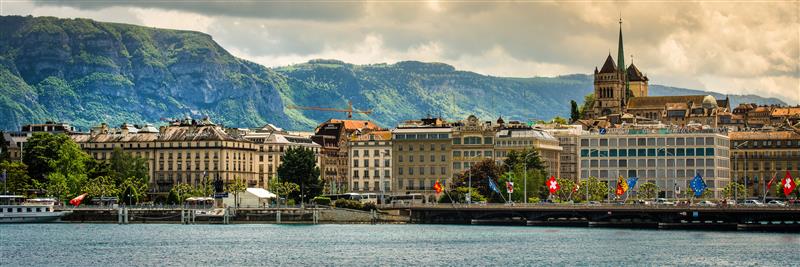
The Geneva Conference was intended to settle outstanding issues resulting from the Korean War and the First Indochina War and involved several nations. It took place in Geneva, Switzerland, from 26 April to 21 July 1954.[1] The part of the conference on the Korean question ended without adopting any declarations or proposals and so is generally considered less relevant. On the other hand, the Geneva Accords that dealt with the dismantling of French Indochina proved to have long-lasting repercussions.
Diplomats from South Korea, North Korea, China, the Soviet Union, and the United States dealt with the Korean side of the conference. On the Indochina issue, the conference involved representatives from France, China, the Soviet Union, the United States, the United Kingdom, the Democratic Republic of Vietnam (DRV), the State of Vietnam, the Kingdom of Laos, and the Kingdom of Cambodia.[2] Three binding ceasefire agreements about Indochina ended hostilities in Vietnam, Laos, and Cambodia. The Pathet Lao were confined to two provinces in northern Laos, and Khmer Issarak forces disbanded. Vietnam was provisionally partitioned at the 17th parallel, with troops and personnel of the DRV regrouping to the North, and those of the State of Vietnam and French Union regrouping to the South. Alongside them, a non‑legally binding Final Declaration called for international supervision (via the International Control Commission), prohibited the introduction of foreign troops and bases in Vietnam, affirmed that the 17th parallel was only a provisional demarcation, and scheduled national elections for 1956.[1] Worsening relations between the communist and anti-communist sides would eventually lead to the Vietnam War. As such, historians generally regard the Geneva Conference as failing to secure lasting peace in Indochina.
Early Insurgency
The Viet Cong[nb 1] (VC) was an epithet and umbrella term to refer to the communist-led armed movement and united front organization in South Vietnam. It was formally organized as and led by the National Liberation Front of South Vietnam,[nb 2] and conducted military operations under the name of the Liberation Army of South Vietnam (LASV). The movement fought under the direction of North Vietnam against the South Vietnamese and United States governments during the Vietnam War. The organization had guerrilla and regular army units, as well as a network of cadres who organized and mobilized peasants in the territory the VC controlled. During the war, communist fighters and some anti-war activists claimed that the VC was an insurgency indigenous to the South that represented the legitimate rights of people in South Vietnam, while the U.S. and South Vietnamese governments portrayed the group as a tool of North Vietnam. It was later conceded by the modern Vietnamese communist leadership that the movement was actually under the North Vietnamese political and military leadership, aiming to unify Vietnam under a single banner.
North Vietnam established the National Liberation Front (NLF) on December 20, 1960, at Tân Lập village in Tây Ninh Province to foment insurgency in the South. Many of the VC’s core members were volunteer “regroupees”, southern Viet Minh who had resettled in the North after the Geneva Accord (1954). Hanoi gave the regroupees military training and sent them back to the South along the Ho Chi Minh trail in the late 1950s and early 1960s. The VC called for the unification of Vietnam and the overthrow of the American-backed South Vietnamese government. The VC’s best-known action was the Tet Offensive, an assault on more than 100 South Vietnamese towns and cities in 1968, including an attack on the U.S. embassy in Saigon. The offensive kept the attention of the world’s media for weeks, but also overextended the VC. Later communist offensives were conducted predominantly by the North Vietnamese. The organization officially merged with the Fatherland Front of Vietnam on February 4, 1977, after North and South Vietnam were officially unified under a communist government.
The Kennedy Era
In the 1960 U.S. presidential election, John F. Kennedy defeated Richard Nixon. Although Eisenhower warned Kennedy about Laos and Vietnam, Europe and Latin America “loomed larger than Asia on his sights.”[143]
Kennedy remained committed to the Cold War foreign policy inherited from the Truman and Eisenhower administrations. In 1961, the US had 50,000 troops based in South Korea, and Kennedy faced four crisis situations: the failure of the Bay of Pigs Invasion he had approved in April,[144] settlement negotiations between the pro-Western government of Laos and the Pathet Lao communist movement in May,[145] construction of the Berlin Wall in August, and the Cuban Missile Crisis in October. Kennedy believed another failure to stop communist expansion would irreparably damage US credibility. He was determined to “draw a line in the sand” and prevent a communist victory in Vietnam. He told The New York Times after the Vienna summit with Khrushchev, “Now we have a problem making our power credible and Vietnam looks like the place.”[146][147]
Kennedy’s policy toward South Vietnam assumed Diệm and his forces had to defeat the guerrillas on their own. He was against the deployment of American combat troops and observed “to introduce U.S. forces in large numbers there today, while it might have an initially favorable military impact, would almost certainly lead to adverse political and, in the long run, adverse military consequences.”[148] The quality of the South Vietnamese military, however, remained poor. Poor leadership, corruption, and political promotions weakened the ARVN. The frequency of guerrilla attacks rose as the insurgency gathered steam. While Hanoi’s support for the VC played a role, South Vietnamese governmental incompetence was at the core of the crisis.[103]: 369 A major issue Kennedy raised was whether the Soviet space and missile programs had surpassed those of the US. Although Kennedy stressed long-range missile parity with the Soviets, he was interested in using special forces for counterinsurgency warfare in Third World countries threatened by communist insurgencies. Although they were intended for use behind front lines after a conventional Soviet invasion of Europe, Kennedy believed guerrilla tactics employed by special forces, would be effective in a “brush fire” war in Vietnam.
Kennedy advisors Maxwell Taylor and Walt Rostow recommended US troops be sent to South Vietnam disguised as flood relief workers.[149] Kennedy rejected the idea but increased military assistance. In April 1962, John Kenneth Galbraith warned Kennedy of the “danger we shall replace the French as a colonial force…and bleed as the French did.”[150] Eisenhower put 900 advisors in Vietnam, and by November 1963, Kennedy had put 16,000.[23]: 131
The Strategic Hamlet Program was initiated in late 1961. This joint U.S.–South Vietnamese program attempted to resettle the rural population into fortified villages. It was implemented in early 1962 and involved forced relocation and segregation of rural South Vietnamese, into new communities where the peasantry would be isolated from the VC. It was hoped these new communities would provide security for the peasants and strengthen the tie between them and central government. However, by November 1963 the program had waned, and it ended in 1964.[6]: 1070 In July 1962, 14 nations, including China, South Vietnam, the Soviet Union, North Vietnam, and the US, signed the International Agreement on the Neutrality of Laos.