1975 Spring Offensive
The 1975 spring offensive (Vietnamese: chiến dịch mùa Xuân 1975), officially known as the general offensive and uprising of spring 1975 (Vietnamese: Tổng tiến công và nổi dậy mùa Xuân 1975), was the final North Vietnamese campaign of the Vietnam War that led to the capitulation of South Vietnam. In December 1974, People’s Army of Vietnam‘s (PAVN) forces crossed from their bases in Cambodia and captured Phước Long Province by January 1975. After this success, the North Vietnamese leadership increased the scope of the PAVN offensive and attacked the Central Highlands from Cambodia in March, capturing the city of Buôn Ma Thuột on 18 March. These operations were intended to be preparatory to launching a general offensive in 1976.
Following these defeats, the South Vietnamese leadership realized they were no longer able to defend the entire country and ordered a strategic withdrawal from the Central Highlands. The retreat was a disaster as civilian refugees fled under fire alongside soldiers along a single highway to the coast. This situation was worsened by confusing orders, lack of command, and a well-led and aggressive enemy, which led to the destruction of most South Vietnamese forces in the Central Highlands. A similar collapse occurred in the northern provinces where PAVN forces captured both Huế and Đà Nẵng by the end of March.
Following the ARVN collapse, North Vietnam transferred its northern forces over 350 miles (560 km) south down the Ho Chi Minh trail through Laos and Cambodia to capture the South Vietnamese capital of Saigon and win the war in time to celebrate their late President Ho Chi Minh‘s birthday. South Vietnamese forces regrouped around the capital and defended the key transportation hubs at Phan Rang and Xuân Lộc, but the South Vietnamese had lost the political and military will to continue. On 21 April, South Vietnamese President Nguyễn Văn Thiệu resigned, hoping the North Vietnamese would reopen negotiations. However, the PAVN continued to attack. While IV Corps southwest of Saigon remained relatively stable, preventing VC units from capturing any provincial capitals, PAVN forces entered Saigon, forcing the South Vietnamese government, now under the leadership of Dương Văn Minh, to surrender on 30 April 1975.
The Human cost
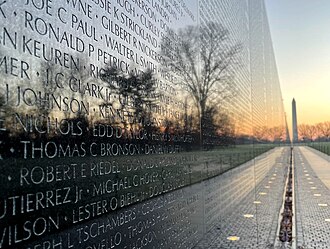
The war exacted an enormous cost: estimates of Vietnamese soldiers and civilians killed range from 970,000 to 3 million. Some 275,000–310,000 Cambodians, 20,000–62,000 Laotians, and 58,220 US service members died.[A 7] The war’s end would precipitate the Vietnamese boat people and the larger Indochina refugee crisis, which saw millions leave Indochina, of which about 250,000 perished at sea.[55][56] 20% of South Vietnam’s jungle was sprayed with toxic herbicides, which led to significant health problems.[57]: 144–145 [58] The Khmer Rouge carried out the Cambodian genocide, and the Cambodian–Vietnamese War began in 1978. In response, China invaded Vietnam, with border conflicts lasting until 1991. Within the US, the war gave rise to Vietnam syndrome, an aversion to American overseas military involvement,[59] which, with the Watergate scandal, contributed to the crisis of confidence that affected the United States throughout the 1970s.[60]
Social Impact in the West
Organized opposition to U.S. involvement in the Vietnam War began slowly and in small numbers in 1964 on various college campuses in the United States and quickly as the war grew deadlier. In 1967 a coalition of anti-war activists formed the National Mobilization Committee to End the War in Vietnam which organized several large anti-war demonstrations between the late 1960s and 1972. Counter-cultural songs, organizations, plays and other literary works encouraged a spirit of nonconformism, peace, and anti-establishmentarianism. This anti-war sentiment developed during a time of unprecedented student activism and right on the heels of the Civil Rights Movement, and was reinforced in numbers by the demographically significant baby boomers. It quickly grew to include a wide and varied cross-section of Americans from all walks of life. The anti-Vietnam war movement is often considered to have been a major factor affecting America’s involvement in the war itself. Many Vietnam veterans, including future Secretary of State and U.S. Senator John Kerry and disabled veteran Ron Kovic, spoke out against the Vietnam War on their return to the United States.
Mrs. Ngo Ba Thanh, a Vietnamese peace activist, aligned her Vietnamese Women’s Movement for the Right to Live with international activists of the Women’s International League for Peace and Freedom (WILPF) and Women Strike for Peace. Her imprisonment and publications about the war brought international attention to the social and economic issues created by the war and fostered international opposition to it.[15]: 109–110 [16]: 85, 89–90 Her arrest and lack of a trial sparked Bella Abzug and WILPF members to write to the United States Congress and petition President Richard Nixon to appeal to South Vietnamese officials for her release,[15]: 126 [16]: 90 which was widely covered in the press.[17][18][19] Campaigns opposing the war and conscription also took place in Australia.[20]
Post-war Vietnam
On 2 July 1976, North and South Vietnam were merged to form the Socialist Republic of Vietnam.[175] The war had devastated Vietnam and killed 966,000 to 3.8 million people.[176][177][178] A 1974 US Senate subcommittee estimated nearly 1.4 million Vietnamese civilians were killed or wounded between 1965 and 1974—including 415,000 killed.[179][180] In its aftermath, under Lê Duẩn‘s administration, there were no mass executions of South Vietnamese who had collaborated with the US or the defunct South Vietnamese government, confounding Western fears,[181] but up to 300,000 South Vietnamese were sent to reeducation camps, where many endured torture, starvation, and disease while being forced to perform hard labour.[182] The government embarked on a mass campaign of collectivisation of farms and factories.[183] Many fled the country following the conclusion of the war.[184] In 1978, in response to the Khmer Rouge government of Cambodia ordering massacres of Vietnamese residents in the border villages in the districts of An Giang and Kiên Giang,[185] the Vietnamese military invaded Cambodia and removed them from power after occupying Phnom Penh.[186] The intervention was a success, resulting in the establishment of a new, pro-Vietnam socialist government, the People’s Republic of Kampuchea, which ruled until 1989.[187] However, this worsened relations with China, which had supported the Khmer Rouge. China later launched a brief incursion into northern Vietnam in 1979, causing Vietnam to rely even more heavily on Soviet economic and military aid, while mistrust of the Chinese government escalated.[188]